Canada's mobile plans are among the most expensive in the world, but you don't have to sign up with the "Big Three" carriers to get reliable service. Thanks to eSIM technology, many Canadian MVNOs and budget carriers now let you activate a local number in minutes without visiting a store or inserting a physical SIM card.Here is a comprehensive, up-to-date guide for navigating the Canadian MVNO and prepaid eSIM market. This resource focuses on getting a cheap, fully functional local Canadian phone number (+1) alongside mobile data, contrasting local flanker brands with traditional data-only travel eSIMs, and detailing step-by-step setup instructions.
What Is a Canadian MVNO?
A Mobile Virtual Network Operator (MVNO) is a wireless service provider that does not own its own cellular network infrastructure — no spectrum licenses, no cell towers, no radio access network (RAN) of its own. Instead, an MVNO delivers mobile services by leasing network capacity from an established Mobile Network Operator (MNO) — one of the major carriers that actually owns and operates the physical infrastructure.
Think of it like an airline charter company: they don't own the planes or the runways, but they rent the seats and sell them to you for a discount.
How MVNOs Work in Canada?
Historically, Canada's telecom market has been dominated by three massive networks (the "Big Three"): Rogers, Bell, and Telus. Because these companies spent billions building the infrastructure across Canada's massive geography, true independent MVNOs were rare for a long time. Today, Canadian MVNOs generally fall into two categories:
-
Flanker Brands (Sub-brands): These are lower-cost brands owned directly by the Big Three to target budget-conscious consumers. For example:
-
Fido and Chatr run on the Rogers network.
-
Virgin Plus and Lucky Mobile run on the Bell network.
-
Koodo and Public Mobile run on the Telus network.
-
-
True / Regional MVNOs: Independent companies that rent space on the major networks or regional networks (like Vidéotron/Freedom Mobile) to offer highly competitive, localized rates (e.g., Fizz or PC Mobile).
Why Choose an MVNO?
-
Lower Cost: Because MVNOs don't have to maintain cellular towers or expensive retail stores, they pass the savings on to you. You can often get the exact same amount of data for half the price of a main network plan.
-
The Exact Same Coverage: If you use an MVNO that runs on the Rogers network, your phone will have signal in the exact same spots a Rogers customer would.
-
No Contracts: Most MVNOs operate on a prepaid or month-to-month basis, meaning you can cancel or change your plan at any time without penalty.
⚠️ The Catch: To keep prices low, MVNOs sometimes cap your data speeds (e.g., limiting you to 4G speeds instead of full 5G) and usually offer customer support strictly through online chat or community forums rather than a phone hotline.
Canada Main Network Overview
Canada's wireless market is dominated by four national networks: Rogers, Bell, Telus, and Quebecor's Freedom Mobile (which became the fourth national carrier after the Rogers-Shaw merger in April 2023). Every other brand resells service from one of these networks as a Mobile Virtual Network Operator (MVNO).
1. The Big Three (The National Infrastructure Owners)
These are the premium brands offering the most extensive coverage, the latest devices, and family plans, typically ranging from $55 to $95 per month.
-
Rogers: Canada's largest subscriber network. Rogers is highly praised for having the most consistent nationwide coverage in major metropolitan areas (like Toronto, Vancouver, and Montreal) and leading the pack in 5G availability.
-
Bell: Bell boasts some of the absolute fastest 5G download speeds in the country. They possess an incredibly stable network with heavy coverage stretching into remote and rural parts of Eastern and Central Canada.
-
Telus: Telus heavily shares cell towers with Bell in a massive infrastructure-sharing agreement (Bell builds out the East, Telus builds out the West). Telus routinely wins awards for network reliability, customer service, and expansive rural coverage in Western Canada (Alberta and BC).
2. The Major Challenger
Freedom Mobile / Vidéotron: Owned by Quebecor, this has officially evolved into Canada's fourth major national carrier. They own their own network infrastructure primarily in Quebec, Ontario, Alberta, and British Columbia, offering heavily discounted rates to compete directly with the Big Three.
Because the Big Three (plus Freedom) own 100% of the physical network, every single budget brand, MVNO, or international travel eSIM you buy is secretly utilizing one of their networks. For example, if you buy a cheap plan from Public Mobile, your phone is connecting directly to Telus towers. If you buy a plan from Fido, you are on the Rogers network. You get the exact same signal coverage, just under a different brand name and a lower price tag.
‼️ Important 2026 Update: The End of Switching Fees
Effective June 12, 2026, a new CRTC regulation banned activation, modification, and cancellation fees for all Canadian carriers. This means you can now switch between providers and plans freely without any penalty.
Cheap Local Numbers vs. Travel eSIMs
Before choosing a plan, you need to decide if you actually need a Canadian phone number ($+1$ country code) or if you just need internet data.
-
Local MVNO eSIMs (Data + Talk/Text): If you need a real local number to look for jobs, receive bank SMS verification codes, or make local calls, you must look at Canadian MVNOs.
-
Travel eSIMs (Data-Only): Providers like Airalo, Nomad, and Saily offer cheap, instant data. However, they do not give you a local phone number. You will rely on WhatsApp, FaceTime, or VoIP for calling.
|
Feature |
Local MVNO eSIMs |
Travel eSIM |
|
Local Canadian Number (+1) |
Yes. You get a real, functional Canadian number for calls, SMS, and bank 2FA. |
No. Almost entirely data-only. (Some provide US/Global virtual numbers, but rarely Canadian). |
|
Network Quality |
Primary Tier 1 network access (LTE/5G) via parent telco. |
Roaming agreements (can sometimes jump networks, but might have higher latency). |
|
Billing Model |
Monthly subscription (prepaid/postpaid, auto-pay). |
One-time prepaid package (e.g., 10GB for 30 days). |
|
Best For |
Newcomers, residents, and long-term visitors needing a consistent local contact number. |
Tourists and short-term visitors who only need maps, translation, and data messaging. |
Top MVNOs with eSIM & Canadian Numbers
|
Provider |
Network |
Starting Price |
eSIM |
Canadian Number |
Best For |
|
Telus 5G |
$22/mo |
✅ Free eSIM |
✅ |
Best overall value |
|
|
Bell 4G |
$19/mo |
✅ |
✅ |
Cheapest entry plan |
|
|
Rogers 4G |
$19/mo |
✅ |
✅ |
Budget flexibility |
|
|
Videotron 5G |
~$12/mo |
✅ |
✅ |
Quebec + customization |
1. Public Mobile
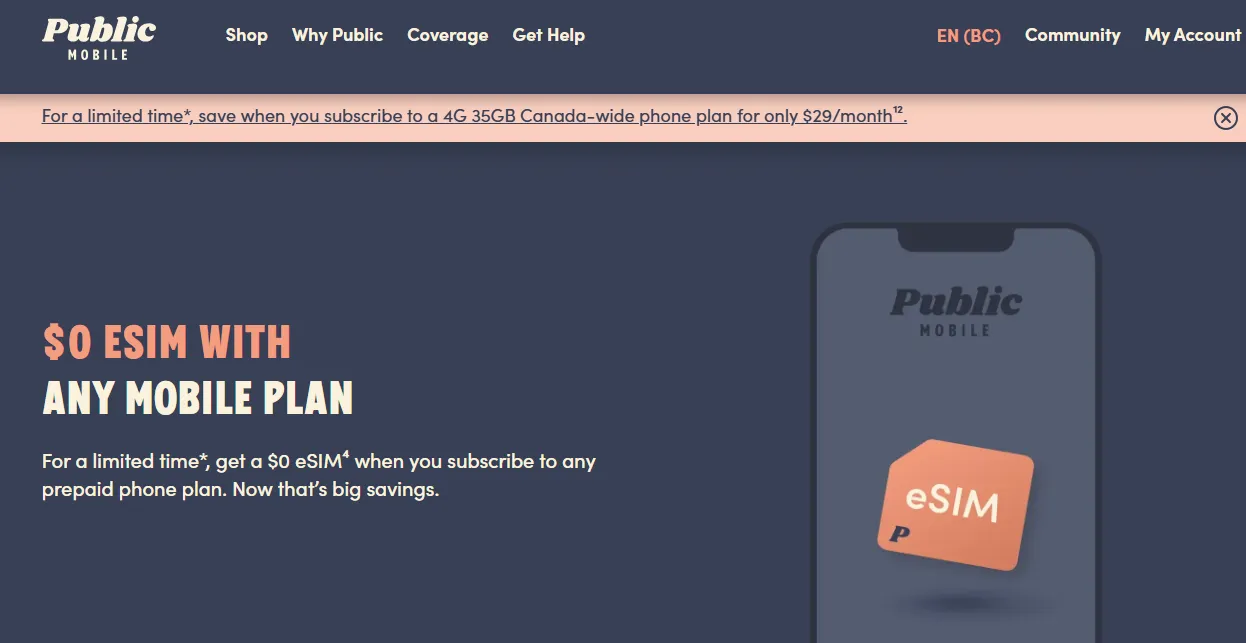
Public Mobile is Telus's digital-only prepaid brand. It is currently one of the most popular options for BYOP (Bring Your Own Phone) eSIM users because of its aggressive 5G pricing.
-
Uses: Telus network
-
Key Plans: Typical plans include affordable 4G options as well as higher-data 5G Canada-US-Mexico bundles, and promotional offers often include free eSIM activation.
-
$22/month: Great for ultra-light users wanting a cheap local number.
-
$29/month: 35GB 4G Data (The sweet spot for budget users).
-
$35/month: 40GB 5G Data with Canada-US-Mexico roaming.
-
$40/month: 100GB 5G Data with Canada-US-Mexico roaming.
-
-
Pros: Access to Telus’s premium nationwide rural coverage; robust 5G speeds; easy app-based eSIM delivery; Canada-US-Mexico plans.
-
Cons: No customer call center; support is strictly community-forum based.
2. Lucky Mobile
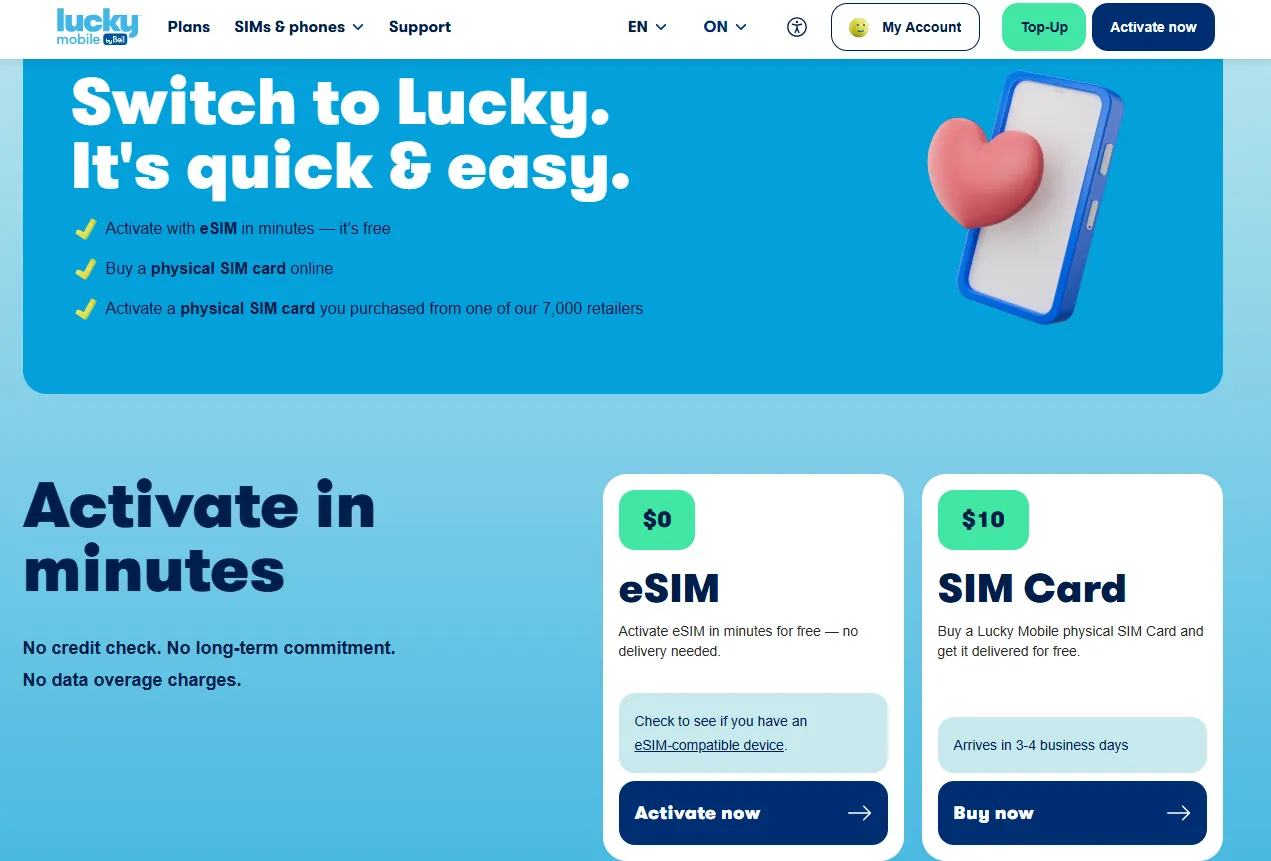
Lucky Mobile is a budget-friendly, prepaid mobile carrier in Canada. It is a subsidiary of Bell Canada. It offers affordable cell phone plans without the need for contracts, credit checks, or hidden fees.
-
Uses: Bell network
-
Key Plans: Plans start at $19/month and include unlimited talk and text. Lucky Mobile only works within Canada.
-
$19/month: 500 MB data (only when Auto Top-Up is enabled).
-
$25/month: 25 GB data (20 GB base + 5 GB bonus).
-
$29/month: 35 GB data (30 GB base + 5 GB bonus).
-
$34/month: 80 GB data (55 GB base + 25 GB bonus).
-
-
Pros: Very affordable; Great nationwide coverage; Easy prepaid setup; Good for light users;Absolute widest retail presence. If you need to walk into a physical store (like a Dollarama, Walmart, or convenience store) to get help, these are your best bets.
-
Cons: Mostly limited to 3G/4G speeds; lacks the advanced 5G capabilities and cross-border features of Public Mobile or the rollover perks of Fizz.
3. Chatr Mobile
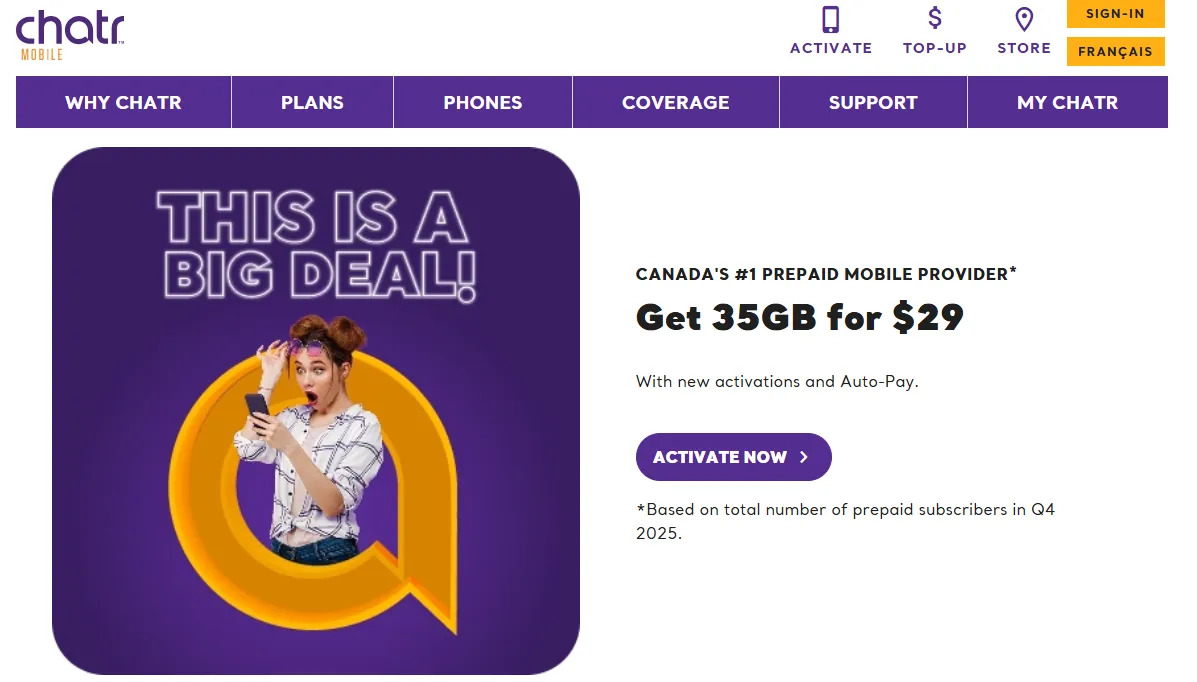
Chatr Mobile is owned by Rogers Communications. It offers affordable, no-contract phone plans focused on talk, text, and data. The carrier is designed for budget-conscious users who want simple pricing with no credit checks or overage fees.
-
Uses: Rogers network
-
Key Plans:
-
$29/mo Plan: Includes 35 GB of 4G data (includes a 5 GB Auto-Pay bonus), unlimited Canada-wide talk, and unlimited international text.
-
$25/mo Plan: Includes 25 GB of data (includes a 5 GB Auto-Pay bonus), unlimited Canada-wide talk, and unlimited international text.
-
$19/mo Talk & Text Plan: Best for minimal data users. Includes 0.5 GB of data (with Auto-Pay), unlimited Canada-wide talk, and unlimited international text.
-
-
Pros: Reliable urban coverage; No contracts; Easy top-up; Affordable plan.
-
Cons: LTE only; Fewer premium options.
4. Fizz Mobile
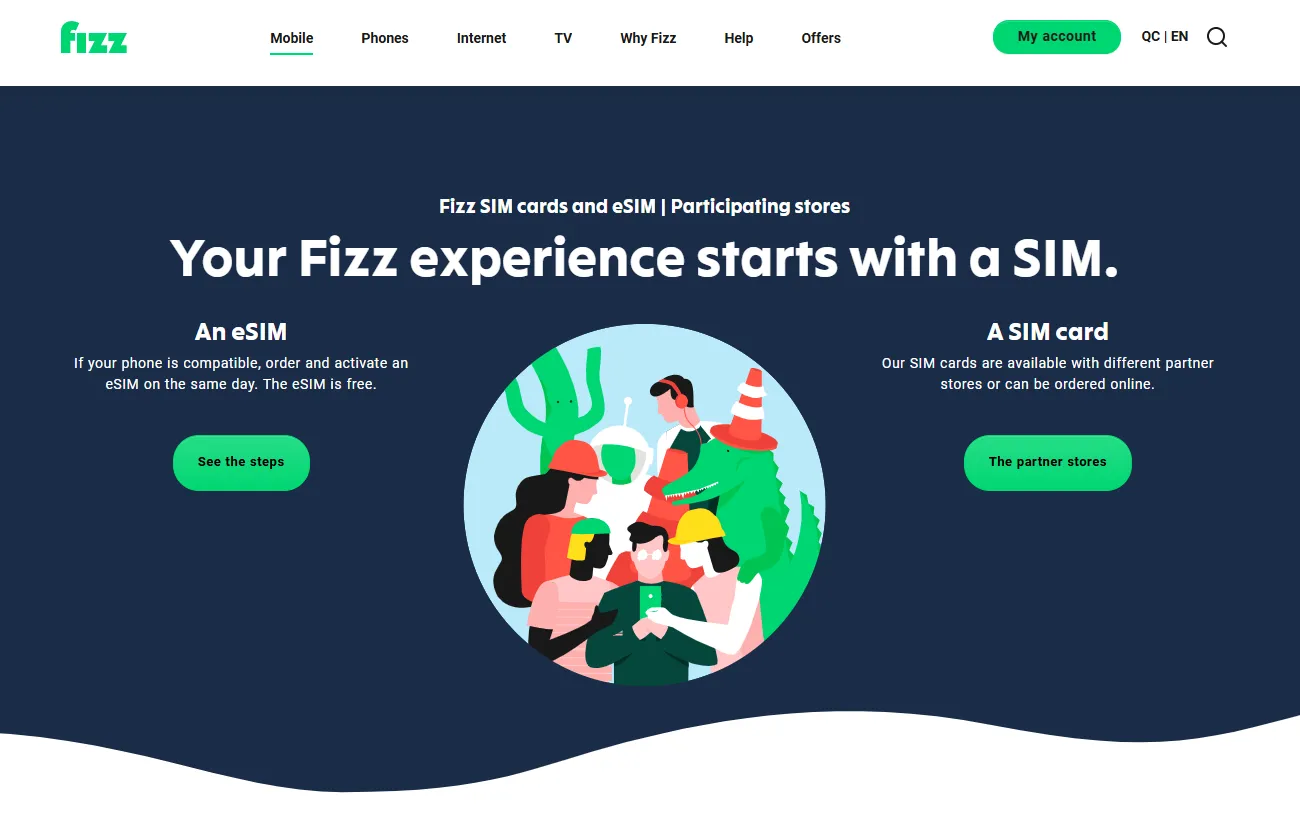
Fizz is a highly innovative digital brand that has expanded rapidly across Alberta, British Columbia, Manitoba, Ontario, and Quebec. It is highly praised for its unique member perks.
-
Uses: Videotron network
-
Key Plans: You choose exactly how much data, talk, and text you need each month.For example, 40GB 5G starts around $35/month.
-
Pros: Data Rollover (unused data carries over to the next month); Data Gifting (you can transfer data to other Fizz users instantly); highly rewarding loyalty program that automatically lowers your bill over time.
-
Cons: Subscription is limited to specific coverage provinces (though it roams nationwide on Rogers' network); coverage in remote Western Canada is slightly weaker than Telus/Bell.
Step-by-Step eSIM Setup Guide
Setting up a Canadian MVNO eSIM can be done entirely from your couch or even before you board your flight to Canada.
Step 1: Verify Device Compatibility
Your phone must be unlocked and support eSIM.
-
Apple: iPhone XS or newer (Note: iPhone 14 and newer models purchased in the US are eSIM-only).
-
Android: Google Pixel 3 or newer, Samsung Galaxy S20 or newer, and most modern flagships.
-
Check by dialing *#06# on your device to see if an "EID" number is listed. If so, your phone supports eSIM.
Step 2: Sign Up and Choose Your Number
-
Go to the website or download the app of your chosen provider (e.g., Public Mobile or Fizz).
-
Choose your plan. (Tip: Look for referral codes online before signing up—Fizz and Public Mobile offer sign-up credits ranging from $10 to $40).
-
During checkout, select eSIM as your SIM card type.
-
You will be prompted to pick a local phone number. Select your province and preferred city area code (e.g., 416 or 647 for Toronto, 604 or 778 for Vancouver).
Step 3: Install the eSIM Profile
Once payment is completed, the provider will send you a QR Code via email or show it directly inside their mobile app.
-
On iOS (iPhone): Go to Settings → Cellular → Add eSIM → Use QR Code. Scan the provided QR code.
-
On Android (Samsung/Pixel): Go to Settings → Connections / Network & Internet → SIM Manager → Add eSIM. Scan the QR code.
Step 4: Configure Dual-SIM Settings (If Traveling)
If you are keeping your home-country SIM active alongside your new Canadian eSIM:
-
Label your lines: Label your home SIM as "Primary" and your Canadian MVNO eSIM as "Canada" or "Travel".
-
Set Default Voice Line: Keep this as your Primary if you need to receive important home-country SMS (like bank 2FA), but turn off data roaming on that line to avoid accidental charges.
-
Set Cellular Data: Set this to your new Canadian eSIM.
-
Allow Cellular Data Switching: Turn this OFF. This ensures your phone does not quietly use your expensive home-country data if the Canadian network momentarily drops.
Insider Tips for Newcomers & Travelers
-
No Credit Checks: Because Public Mobile, Fizz, and Lucky Mobile operate on a prepaid model, you do not need a Canadian credit history, credit score, or social insurance number (SIN) to sign up. You only need a valid credit/debit card to set up auto-pay.
-
Keep Your Number Active: If you are leaving Canada temporarily but want to keep your Canadian phone number, you can park it on a cheap plan (like Public Mobile’s $15–$22 options) or port it to a VoIP service like VoIP.ms or Fongo for a nominal fee.
-
Cross-Border Travel: If you plan on visiting the United States during your stay, choosing a Public Mobile plan with built-in US roaming (like their $35 or $40 tiers) is significantly cheaper than buying daily roaming add-ons.
FAQs
Which Canadian MVNO has the best coverage?
Public Mobile (TELUS), Lucky Mobile (Bell), and Chatr (Rogers) all provide excellent nationwide coverage through Canada's major carrier networks.
Which provider is the cheapest?
Lucky Mobile, Chatr Mobile, and Public Mobile frequently offer the lowest entry-level prepaid plans, while promotions can significantly change the best value month to month.
Is eSIM free?
Some providers charge a small activation fee, while others periodically waive the eSIM fee during promotions. Public Mobile, for example, has recently offered free eSIM activation with eligible plans.
Do I need a Canadian ID?
Not always. Many prepaid services allow activation using a passport or other identification, depending on the provider.
Can I activate before arriving in Canada?
Some providers allow online registration and eSIM setup before arrival, while others require activation after entering Canada.
Can You Keep Your Existing Number?
Yes. Canadian number portability allows you to move your number between most providers.
Can Tourists Buy a Canadian eSIM?
Yes. Most prepaid MVNOs allow tourists to purchase.
Can You Use Dual SIM?
Absolutely. Modern iPhones and many Android devices support dual SIM using eSIM.