Japan's mobile market has evolved rapidly, and eSIM adoption is now widespread among both major carriers and budget-friendly providers. However, Japan’s strict identity verification laws still present unique hurdles for anyone looking to secure a real, local phone number (070, 080, or 090 prefixes) for calls and SMS verification.Fortunately, Mobile Virtual Network Operators (MVNOs—smaller providers running on major networks like Docomo, au, or SoftBank) have adapted. Whether you're relocating to Japan, studying abroad, working remotely, or simply planning a longer visit, understanding the differences between these providers can help you avoid unnecessary costs. In this comprehensive guide, I'll break down the leading Japanese budget carriers, compare their strengths and limitations, and walk you through the eSIM activation process step by step.
What is an MVNO & Why Choose It Over Major Carriers?
A Mobile Virtual Network Operator (MVNO) is a provider that doesn't own its own network infrastructure but leases capacity from Japan's major carriers (MNOs) – NTT Docomo, au (KDDI), and SoftBank – and resells it at significantly lower prices.
With eSIM adoption accelerating (especially following the iPhone 17 series' eSIM-only design), MVNOs are now required to offer eSIM support to remain competitive. he government is also actively enforcing that MNOs provide eSIM functionality to MVNOs under fair terms to ensure competitive market conditions.
‼️ The Difference: Major Carrier vs. MVNO
|
Factor |
MNOs (Docomo, au, SoftBank) |
MVNOs |
|
Monthly Cost |
¥7,000–10,000+ |
¥950–3,300 |
|
Network Ownership |
Own physical infrastructure (masts, spectrum, core network) |
Lease from MNOs |
|
Speed Priority |
Higher priority during peak congestion |
May experience slowdowns during busy hours (lunchtime, commuting) |
|
In-Store Support |
Extensive physical store network |
Mostly online-only |
|
Contract Flexibility |
Longer contracts, cancellation fees |
More flexible, often month-to-month |
For most travelers, expats, and budget-conscious locals, choosing an MVNO is a no-brainer. Here is why:
1. Massively Lower Costs
Because MVNOs don't have to spend billions of dollars maintaining physical cell towers or running brick-and-mortar retail stores, they pass those massive savings directly to you. You are getting the exact same coverage footprint for a fraction of the price.
2. No Long-Term Contracts
Major carriers love to lock you into 1-year or 2-year contracts with hefty early-termination fees. MVNOs almost exclusively operate on a pay-as-you-go, month-to-month, or prepaid model. If you are traveling for 3 weeks, you buy a 3-week plan and walk away with no strings attached.
3. Tailored Plans for Travelers & Expats
Major Japanese carriers (like Docomo or SoftBank) make it incredibly difficult for non-residents to sign up for a plan. They require Japanese bank accounts, official residence cards, and complex paperwork. MVNOs specialize in cutting through that red tape, allowing you to sign up online in seconds with just a credit card and a passport.
4. You Don't Sacrificial Coverage
If you buy an MVNO eSIM that runs on the Docomo network, your phone will connect to the exact same cell towers as a local paying top-dollar for a premium Docomo contract. Your coverage in deep subway lines or rural mountains will be identical.
⚠️ The One Catch: Network Prioritization
If you are at a massive, packed event—like a crowded festival in Kyoto or a sold-out concert at the Tokyo Dome—the host network will prioritize its own direct customers first. During those peak traffic moments, your MVNO data speeds might temporarily slow down, whereas a premium carrier user won't feel the lag. For 95% of daily use, however, you won't notice a difference.
Best Japan MVNO eSIM Providers
If you need a real local number, your options split based on your residency status.
A. For Long-Term Residents & Digital Nomads (With Residence Card)
If you hold a Residence Card (Zairyu Card) and a registered address in Japan, you can access the cheapest native MVNO rates.
1. IIJmio
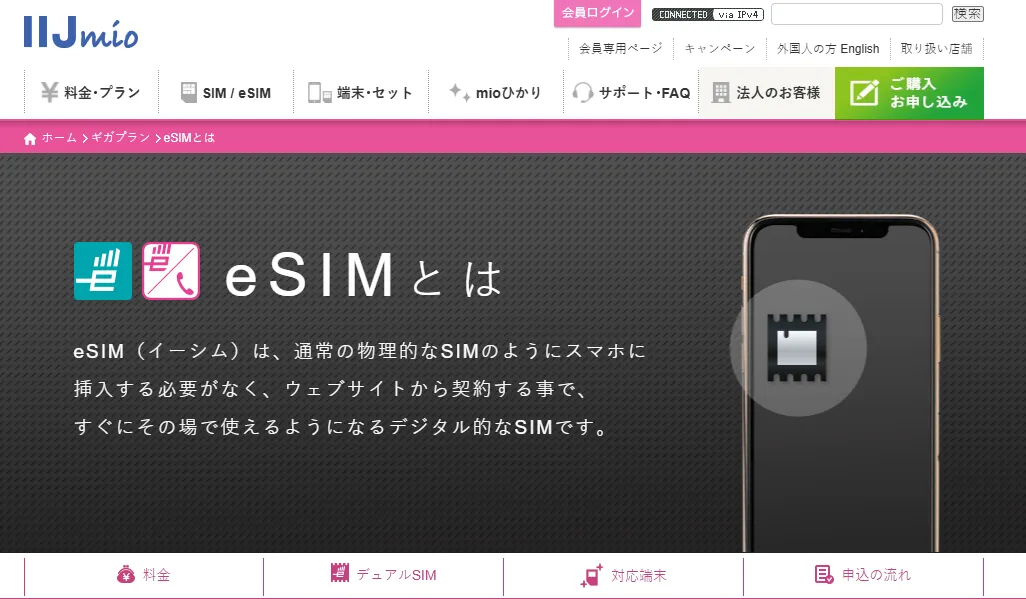
IIJmio remains the undisputed gold-standard MVNO for residents in Japan, offering some of the lowest pricing structures in the industry through their flagship Giga Plan (ギガプラン). They offer full eSIM support for both local voice/SMS lines and data-only connections.It operates on the NTT Docomo and au networks.
✔️ Pros:
-
Extremely competitive monthly pricing.
-
Stable Docomo network access.
-
Online application available.
❌ Cons:
-
English support is limited.
-
Some eSIM offerings focus primarily on data services.
Typical Plans:
You can choose a plan size based on your monthly data needs. Unused data carries over to the following month.A standard administrative contract fee of ¥1,650 applies.
|
Data Limit |
Voice eSIM (Docomo/au) |
Data-Only eSIM (Docomo Only) |
|
2GB |
¥850 |
¥440 |
|
5GB |
¥550 (Special deal until November 4, 2026) |
¥650 |
|
10GB |
¥1,400 |
¥1,050 |
|
15GB |
¥1,600 |
¥1,320 |
|
25GB |
¥900 (Special deal until November 4, 2026) |
¥1,650 |
2. povo 2.0
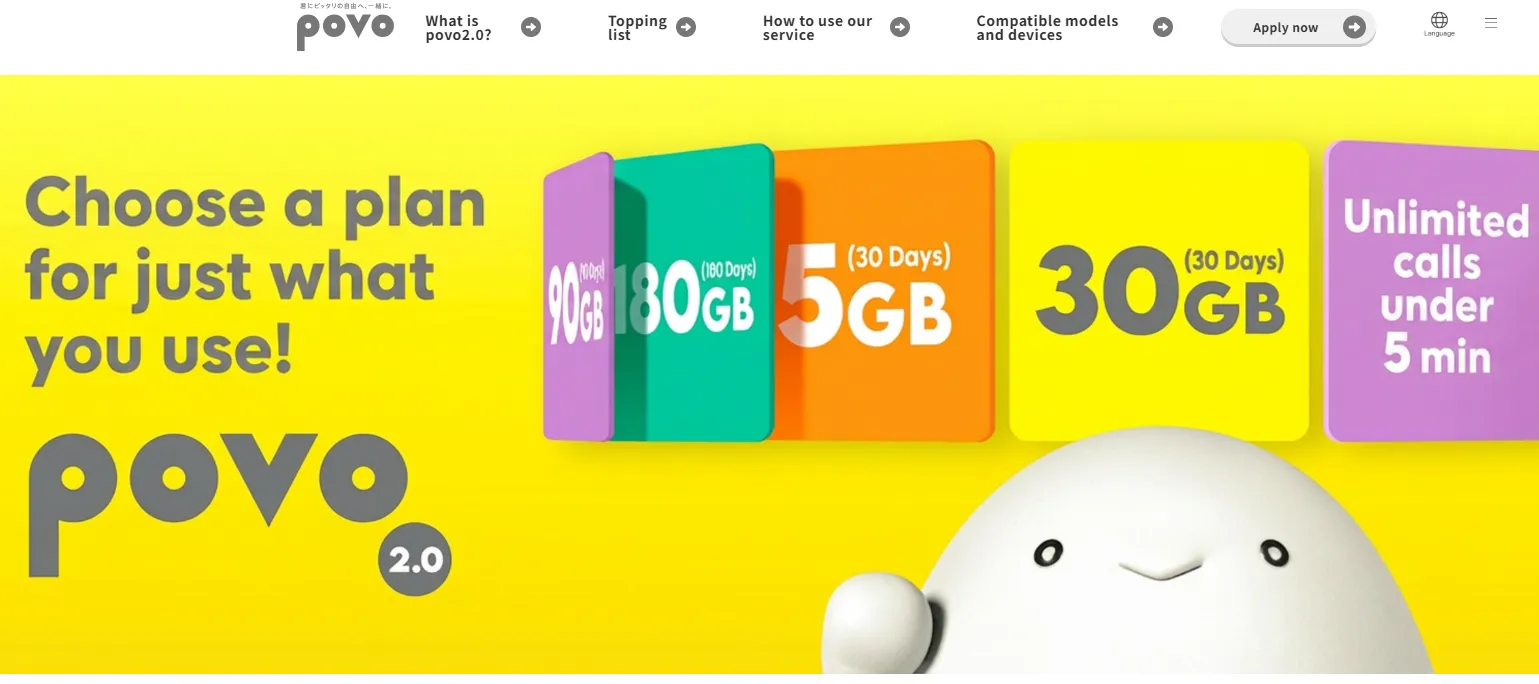
povo 2.0's eSIM is an incredibly flexible, ¥0-base-fee mobile plan offered by KDDI in Japan. It is highly praised for its "pay-as-you-go" data toppings, making it ideal for both dual-SIM smartphone users and travelers who want to avoid expensive roaming fees.
✔️ Pros:
-
No fixed monthly fee,pay only for what you use.
-
eSIM activation is straightforward.
-
Excellent au coverage.
-
High-speed 5G network.
❌ Cons:
-
Requires topping purchases periodically.
-
Plan structure may confuse first-time users.
Typical Plans:
Instead of charging a fixed monthly fee, povo operates on a "Topping" model, allowing you to pay only for the exact services you use.Without any toppings active, you can still:
-
Receive unlimited incoming phone calls.
-
Receive unlimited incoming SMS verification messages (critical for setting up Japanese apps).
-
Use background mobile data throttled to $128\text{ Kbps}$ (too slow for video, but works for text-based messaging in an emergency).
B. For Non-Residents, Tourists, & Working Holidaymakers (Passport-Friendly)
If you do not have a Residence Card, most Japanese carriers will refuse to sell you a voice-enabled SIM. However, specialized expat-friendly MVNOs have bypassed this by allowing passport-only verification.
1. Mobal
Mobal is the most famous provider offering real 070/080/090 Japanese phone numbers to tourists and non-residents.
✔️ Pros:
-
Requires only a passport for verification (no residency card needed).
-
Outstanding English-speaking support.
-
Physical offices in Tokyo for help.
-
Has a 2026 "Voice+Data 5G eSIM" upgrade that supports limited international roaming for receiving SMS/calls outside Japan.
❌ Cons:
- Outgoing calls and SMS rates are relatively expensive if used heavily.
Typical Plans:
Monthly Voice + Data eSIM plans starting at ¥990 for the base active number (with calls/SMS charged on a pay-as-you-go basis), up to various high-data options.
2. Sakura Mobile
Sakura Mobile is another highly-rated premium local provider tailored to expats, students, and digital nomads.They offer data-only and voice eSIMs running on NTT Docomo (the widest coverage in Japan). Everything from billing to support is completely in English, making them a smooth bridge into Japan's local network.
✔️ Pros:
-
100% English support.
-
It uses NTT Docomo or au infrastructure (native routing for lower latency).
-
Excellent coverage in rural Japan.
❌ Cons:
- Higher initial setup activation fees compared to mainstream resident-only MVNOs.
Typical Plans:
|
High-Speed Data Limit |
Monthly Plan Price |
|
5GB |
¥2,980/month |
|
15GB |
¥3,480/month |
|
30GB |
¥3,980/month |
|
40GB |
¥4,980/month |
|
60GB |
¥6,980/month |
|
100GB |
¥10,980/month |
A steep ¥5,500 (tax included) setup fee applies at application.
Recommended Data Tiers: How Much Do You Need?
Avoid "Unlimited Data" plans unless they explicitly state their Fair Usage Policy (FUP). Many travel eSIMs advertise "unlimited" but throttle your speed down to an unusable 128 Kbps after you hit 2 GB or 3 GB in a single day. Fixed-data bundles give you 100% full unthrottled speed.
-
Light Use (5 GB - 10 GB / 30 Days): Ideal if you just need Google Maps, train schedule apps (like Navitime), and casual messaging.
-
Standard Use (20 GB / 30 Days): The "sweet spot" for a 1-to-2-week trip. Reassuringly covers heavy navigation, photo uploads to social media, and translation apps without needing to constantly monitor your usage.
-
Heavy Use (50 GB+ or True Multi-Network): Best for remote workers, video streamers, or those continuously tethering/hotspotting a laptop.
Step-by-Step eSIM Setup Guide
Setting up an MVNO eSIM is straightforward, but timing is critical. Always download the eSIM profile while you are still at home on a stable Wi-Fi connection.
Step 1: Purchase & Check Compatibility
Ensure your phone is carrier-unlocked and supports eSIM. Buy your chosen plan online. You will immediately receive a confirmation email containing a QR code or manual activation details.
Step 2: Install at Home (Before You Fly)
Do not wait until you land in Tokyo to scan the code, as airport Wi-Fi can be spotty.
-
Go to your phone’s settings:
-
iOS: Settings > Cellular > Add eSIM > Use QR Code. Scan the code.
-
Android: Settings > Network & Internet > SIMs > Add eSIM / Download SIM. Scan the code.
-
-
Label the Line: Name your primary line "Home" and the new eSIM line "Japan".
-
Keep the Line Off: Turn the "Japan" eSIM line OFF until you physically board your flight or land in Japan.
Step 3: Activate Upon Landing in Japan
Once the wheels touch down in Japan:
-
Turn your Japan eSIM line ON.
-
Set your Cellular Data / Mobile Data default line to your Japan eSIM.
-
Turn on Data Roaming specifically for the Japan eSIM (many travel eSIMs require roaming toggled on to hook into local networks, and this will not incur charges on your local eSIM).
-
Keep your Home SIM line ON if you need to receive incoming home-country SMS codes, but turn OFF Data Roaming for your Home line to avoid expensive carrier roaming fees.
Common Issues & Troubleshooting
|
Issue |
Solution |
|
eSIM not activating after scanning QR code |
Check internet connection; ensure device is unlocked; restart phone; re-scan QR code. |
|
No data after landing |
Enable Data Roaming for the Japan eSIM line; check APN settings; confirm plan start date hasn't passed. |
|
Japanese apps not working (banking, streaming) |
Issue: your eSIM routes through non-Japanese servers. Fix: Use VPN to Japanese server; switch to local-routing provider (CDJapan, Mobal); request refund. |
|
Can't receive SMS codes |
Data-only eSIMs don't have SMS capability. To receive SMS: Get voice-enabled SIM (requires ID verification). |
|
Slow speeds during peak hours |
MVNO deprioritization during lunchtime/commuting hours. Switch to provider with better priority (sub-brand like ahamo or UQ Mobile). |
|
ID verification failed |
Ensure passport photo is clear and matches selfie; double-check information entered matches exactly; try different provider if persistent. |
|
Plan expiring too soon |
Check activation timing – most expire from activation date, not purchase date. Install but don't enable until arrival. |
|
Can't make calls |
Confirm you have voice-enabled SIM; check dialing prefix (always use 0 plus area code); ensure call credit available. |
Frequently Asked Questions
Is eSIM common in Japan in 2026?
Yes. Most major carriers and several MVNOs now support eSIM activation.
Can foreigners get a Japanese phone number?
Yes, provided they meet the provider's identity requirements and have an eligible residence status.
Which network has the best coverage?
Generally:
-
Docomo: Strongest nationwide coverage.
-
au: Excellent urban and suburban performance.
-
SoftBank: Fast speeds in major cities.
Is Rakuten Mobile an MVNO?
No. Rakuten operates its own network, although many people compare it with MVNOs because of its competitive pricing.
Can You Keep Your Existing Number?
Yes.Japan supports MNP (Mobile Number Portability).You can transfer your number when moving between providers.