Stepping off the plane in Hanoi or Ho Chi Minh City, the first thing every traveler needs is reliable mobile data. Roaming fees can be brutal, and hunting for a physical SIM card at a crowded airport stall is the last thing you want after a long flight. Fortunately, modern eSIM services make it possible to get connected within minutes — often before your flight even lands.This guide explains everything travelers need to know before arriving in Vietnam, including where to purchase an eSIM, how activation works, which providers offer the best coverage, and whether you can get a Vietnamese phone number for calls, SMS verification, and local services. You’ll also find practical tips on compatibility, setup, pricing, and avoiding common mistakes when switching networks abroad.
Why Use an eSIM in Vietnam?
An eSIM (embedded SIM) is a digital SIM card built into your smartphone. Instead of swapping plastic cards, you scan a QR code and activate mobile data instantly—no need to visit a shop, no need for a SIM ejection tool, and no risk of losing your home SIM.Using an eSIM for a trip to Vietnam is vastly superior to relying on international roaming or hunting down a physical SIM card at the airport.
Here is exactly why making the switch makes your travels smoother:
|
Benefit |
Why It Matters |
|
Instant activation |
Connect the moment your plane lands. No queuing at airport kiosks. |
|
Digital purchase |
Buy online from anywhere—at home, on the train, or at the airport. |
|
Keep your home number |
Your physical SIM stays active for calls and texts from home. |
|
Flexible plans |
Choose from daily, fixed-data, or unlimited options for 3–30 days. |
|
No passport hassle |
Most tourist eSIMs come pre-registered—no identity verification required at the counter. |
|
Environmentally friendly |
No plastic card to dispose of after your trip. |
Vietnam has excellent mobile internet coverage and some of the cheapest data plans in Southeast Asia, making eSIMs an especially attractive option for tourists in 2026.
Device Compatibility & Checklist
Before pulling the trigger on a Vietnam eSIM, you need to ensure your device is carrier-unlocked and supports eSIM technology. Having a brand-new phone isn't always enough—regional manufacturing rules and carrier locks can still get in the way.
1. Quick Check
The absolute fastest way to see if your phone supports eSIM technology is to check for an EID (Embedded Identity Document) number.
-
The Universal Shortcut: Open your phone’s phone/dialer app, type
*#06#, and hit call. -
What to look for: A screen will pop up listing your phone's serial numbers (IMEI, etc.). If you see an EID number listed, your phone has an internal eSIM chip and is hardware-compatible.
2. Checking via Settings
-
iPhone: Go to Settings > Cellular (or Mobile Data). If you see an option that says "Add eSIM" or "Set Up Cellular," your phone is compatible.
-
Samsung / Android: Go to Settings > Connections > SIM Manager. If you see "Add eSIM", you are good to go.
Almost all modern smartphones support eSIMs in Vietnam, as local Vietnamese carriers (Viettel, Vinaphone, and MobiFone) use standard global eSIM protocols.
|
Brand |
Model |
|
Apple |
|
|
Samsung |
|
|
|
|
|
Other Android Brands (Global Variants Only) |
|
Vietnam's Mobile Networks: Viettel vs. Vinaphone vs. MobiFone
Nearly all eSIMs sold to tourists connect to one of Vietnam's three major carriers. Understanding their strengths helps you choose the right plan for your itinerary.
|
Pros |
|
|
|
|
Cons |
|
|
|
|
Best For |
|
|
|
1. Viettel – Best Nationwide Coverage (Market Leader)
Viettel is a state-owned military telecom and Vietnam‘s largest mobile operator. It offers the widest coverage in the country—approximately 98% nationwide—with reliable 4G and expanding 5G networks. If your itinerary includes remote destinations like Sapa, Ha Giang, Ha Long Bay, or the Mekong Delta, a Viettel-based eSIM is your safest choice. Independent testing consistently ranks Viettel as the strongest network for coverage and stability across Vietnam.

2. Vinaphone – Best for Urban Speed
Vinaphone (operated by VNPT) performs exceptionally well in major cities like Hanoi, Ho Chi Minh City, and Da Nang. It often delivers the fastest download speeds in urban centers, making it popular among city-based travelers, remote workers, and content creators who need high-speed uploads.

3. MobiFone – Best Value & Visitor-Friendly
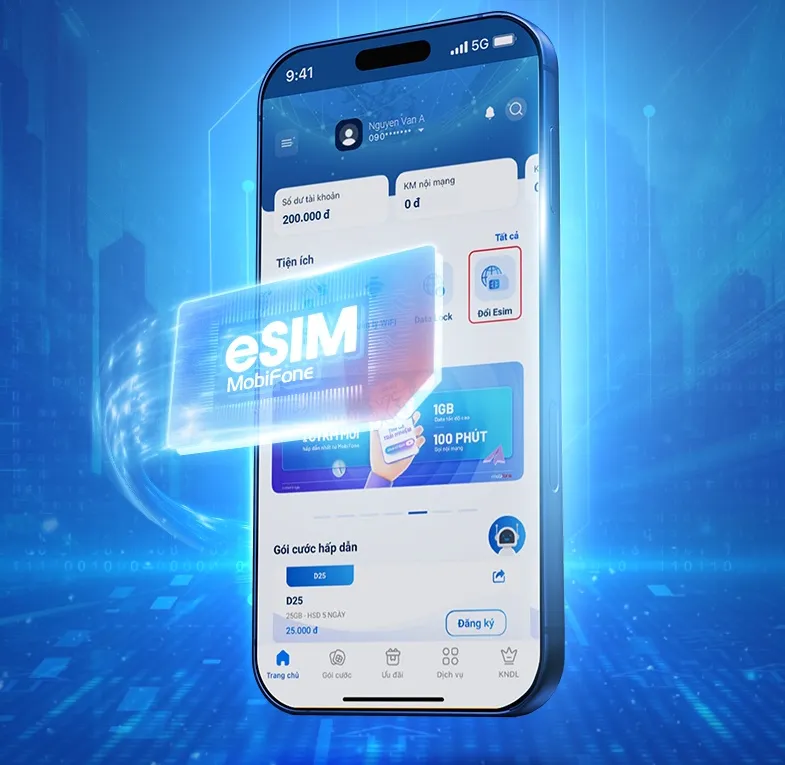
MobiFone is Vietnam‘s second-largest carrier and an excellent choice for budget-conscious travelers. It provides stable coverage in cities and tourist areas, with generous data packages at competitive prices. For tourists who want a local number with calls and SMS included, MobiFone offers some of the most visitor-friendly eSIM plans.
How to Buy an eSIM for Vietnam?
You have two main paths when purchasing a Vietnam eSIM: buying from a global travel provider before you leave, or purchasing from a local Vietnamese telecom operator.
|
Global Travel Providers |
Local Vietnamese Operators |
|
| Best For |
|
|
| Downsides |
|
|
Option A: Global Travel Providers (Most Convenient)
Providers like Airalo, Holafly, Nomad, and MobiMatter sell regional and country-specific data plans.
-
How to buy: Simply visit their website or download their app, select Vietnam, pick a plan, and pay via credit card, Apple Pay, or Google Pay.
-
Delivery: You will instantly receive a QR code and installation instructions via email.
- The Catch: These are almost exclusively data-only plans and do not include a local phone number.
Option B: Local Vietnamese Operators
Vietnam’s big three carriers—Viettel, Vinaphone, and MobiFone—all support eSIM technology.
-
How to buy: You can purchase these at official carrier stores in major city centers or at international airports (HAN or SGN). Some authorized online aggregators (like Gigago) sell local network eSIMs in advance.Airport queues can be long, and language barriers can make store registration tedious.
-
The Catch: In accordance with Vietnam’s telecommunications regulations, all SIM cards, including eSIMs, must be registered under a valid form of identification. You must present your valid, physical passport containing your portrait photo and personal information page. Digital copies or pictures of your passport cannot be accepted.
Best Vietnam eSIM Plans for Tourists
Here are the top picks for different traveler profiles:
|
Provider |
Best For |
Typical Pricing & Plans |
Underlying Network |
|
Heavy users (Unlimited Data) |
$3.90 for 1 day up to $74.90 for 30 days (Unlimited data with hotspot limits) |
Vinaphone |
|
|
Short trips & light users |
€4 (1 GB / 3 days) to €43.50 (50 GB / 30 days) |
Vinaphone |
|
|
Travelers who want the most reliable 5G connection |
$3.99 (1 GB / 7 days) to $28.99 (20 GB / 30 days) |
Varies (often Vinaphone or multi-network) |
|
|
Budget short trips |
$4 (1 GB / 4 days) to $39.99 (40 GB / 30 days) |
Viettel |
Getting a Local Vietnamese Phone Number (+84)
Most travel eSIMs are data-only—they provide internet access but no local phone number for calls or SMS. However, having a local Vietnamese number can be incredibly useful for:
-
Ride-hailing apps (Grab): Drivers frequently call to confirm pickup locations. Without a local number, communication is difficult.
-
Restaurant reservations: Many local establishments still rely on phone bookings.
-
Food delivery: Ordering via ShopeeFood or GrabFood requires a valid local number.
-
Account verification & OTPs: Some local services need SMS verification.
Do You Really Need a Local Number?
For most short-term tourists, the answer is no. If your trip is 5–10 days and you primarily need data for maps, Grab, WhatsApp, and browsing, a standard travel eSIM works perfectly.
If you expect to make local calls, need domestic SMS, want a number for signups, or are staying longer, then a real local number is worth the extra effort.
Three Ways to Get a Vietnam eSIM with a Local Number
Option 1: ByteSIM (Simplest, No Passport Required)
ByteSIM offers an eSIM with a native Vietnamese (+84) number on the MobiFone 5G network. No passport scan or identity verification is required, and the eSIM includes incoming calls and SMS.Some packages include outgoing minutes and SMS, while others are incoming-only—read the plan specifications before purchasing.
Option 2: Sim Local (MobiFone Partnership)
Sim Local partners directly with MobiFone to offer local eSIM plans that include high-speed data, calls, texts, and a local Vietnamese number. Their 75GB/15-day plan and 150GB/15-day plan are designed specifically for tourists needing full functionality, including hotspot support.
Option 3: Local Carrier eSIMs (Viettel / Vinaphone / MobiFone)
Vietnamese carriers all offer eSIM options with real local numbers. However, buying directly from a carrier typically requires in-person registration at a store with your passport—defeating the convenience of eSIM. For most tourists, the first two options above are far easier.
The Multi-Step Guide to Activation
To ensure a smooth setup, install your eSIM at home while you still have a stable Wi-Fi connection before boarding your flight.
-
Step 1: Verify compatibility. Make sure your smartphone is carrier-unlocked and supports eSIM technology.
-
Step 2: Scan the QR code. Go to your phone’s network settings (Settings > Cellular/Mobile Data > Add eSIM) and scan the QR code provided by your vendor.
-
Step 3: Label your lines. Label your primary home SIM as "Primary" and your new Vietnam eSIM as "Travel" or "Vietnam."
-
Step 4: Keep the line off until landing. Keep the travel line toggled Off while in transit.
-
Step 5: Activate upon arrival. Once your plane touches down in Vietnam, toggle your Vietnam eSIM line On and set it as your primary line for Cellular Data.
-
Step 6: Turn on Data Roaming. For almost all global travel eSIMs to function, you must turn on Data Roaming specifically for the travel eSIM line.
⚠️ Important: Do not turn on data roaming for your home SIM line unless you want unexpected roaming fees from your domestic carrier.
Frequently Asked Questions (FAQ)
Q1: How much does a Vietnam eSIM cost?
Entry-level plans start as low as 1–4for1GBover3–7days,withtypical10–15GBplansrangingfrom1–4for1GBover3–7days,withtypical10–15GBplansrangingfrom10–20, and unlimited plans from $20–75 depending on duration.
Q2: Will my eSIM work in remote areas like Sapa or Ha Giang?
Yes, if your eSIM connects to Viettel network. Viettel covers approximately 98% of Vietnam, including mountainous regions. eSIMs on Vinaphone or MobiFone may have weaker signals outside cities.
Q3: Do I need to register my passport for a tourist eSIM?
For most travel eSIMs purchased from global providers (Airalo, Holafly, Saily, Roamify, Jetpac): No registration required. For local carrier eSIMs or some platforms (like ByteSIM for numbers), registration rules vary. Many 2026 tourist eSIMs come pre-registered.
Q4: Can I use my Vietnam eSIM in other countries?
Not unless you purchase a regional Southeast Asia plan. For multi-country trips, look for providers offering Vietnam + Thailand + Malaysia + Singapore combined eSIMs.
Q5: Can I tether/hotspot from my eSIM?
Yes, most Vietnam eSIMs support hotspot sharing. However, tethering to multiple devices may slow your connection.
Q6: How do I check my remaining data?
Most providers include a data tracker in their app. Some offer USSD codes (e.g., Viettel eSIMs can dial *098# to check usage).
Q7: What if my eSIM doesn’t work after landing?
First, ensure Data Roaming is ON. Then try restarting your phone. If still no connection, manually select a network from Settings > Cellular > Network Selection. Contact your provider’s 24/7 support if issues persist.
Q8: Can I buy an eSIM after arriving in Vietnam?
Yes—many providers offer instant delivery via email, and you can install using airport Wi-Fi. However, installing before departure saves time and stress.
Q9: Will WhatsApp / FaceTime / iMessage work?
Yes, all internet-based messaging apps work perfectly. You don’t need a local number for these services.
Q10: Are there any age restrictions for buying an eSIM?
No—eSIMs can be purchased by any traveler. Vietnam’s mobile regulations focus on identity verification for local numbers, not age restrictions on data-only eSIMs.